










Indeed, driver wellness is barely an earshot away from the technological and insurance shift that is on the verge of pushing the way we view health standards into the performance, safety, and financial realms, thereby determining the future driver health across the sector.
In transportation, driver health is a talking point that has been there all the while, but it never had a proper title. At some point, that was a clear-cut mechanism – take a medical test, avoid legal issues, get on the truck. Things have changed; this is not enough. The paradigm of truck driving is changing due to health technology, insurance, and transportation regulations, which are introducing new standards that say health is as important as profit, safety, and financial stability.
So, tech- and insurance-driven commercial driver health is no longer a question of truckers only but instead has become a decisive player in fleet insurance costs, fleet reliability, regulatory exposure, and long-term sustainability. With fleets being more data-driven and regulators swapping over from punishing to prevent, regulatory changes are making driver health a management responsibility and not a side matter.
Why Driver Health Has Become a Strategic Issue
The transport business faces dysfunctional environmental, mental, and social conditions all year round. Heavy and erratic workloads, difficult access to healthy diets, and disruptive sleep patterns combine to create a situation that both insurers and regulators cannot afford to overlook in present-day health and safety standards.
The major drivers of this disruption are as follows:
- The increase in driver insurance costs associated with medical claims and accidents
- Increased scrutiny of drivers in relation to fatigue, consciousness, and health
- The increasing understanding of occupational health hazards in the transportation sector
- The existing driver shortage constraining fleets from using less experienced drivers
Overall driver health is now a major direct factor in the cost equation. It directly drives up the premiums, lowers the performance of the fleet, makes the employee turnover higher, and extends the liability exposure. This is why fleet health management is now more about operational efficiency rather than just compliance — and why driver safety is increasingly tied to health strategy.
Technology and Health Monitoring in a New Context
Driver wellness is experiencing a major boost with modern health technologies that have moved observation from fixed, yearly medical exams to continuous, frictionless observation of actual conditions of the car and the driver.
Telematics Beyond the Truck
Telematics is the set of tools and technologies devoted to both safety and efficiency but, at the moment, they are being transformed into health monitoring through the development of:
- Fatigue-related driving patterns
- Lanes stray and braking faults as forerunners of problems
- Incongruent rest periods, idle time, and schedule-induced strain
Along with driving, telematics don’t diagnose any medical issues. Nevertheless, they enhance driver safety by pointing out behavioral patterns that correlate with health issues that may appear.
Wearables and Driver Health Technology
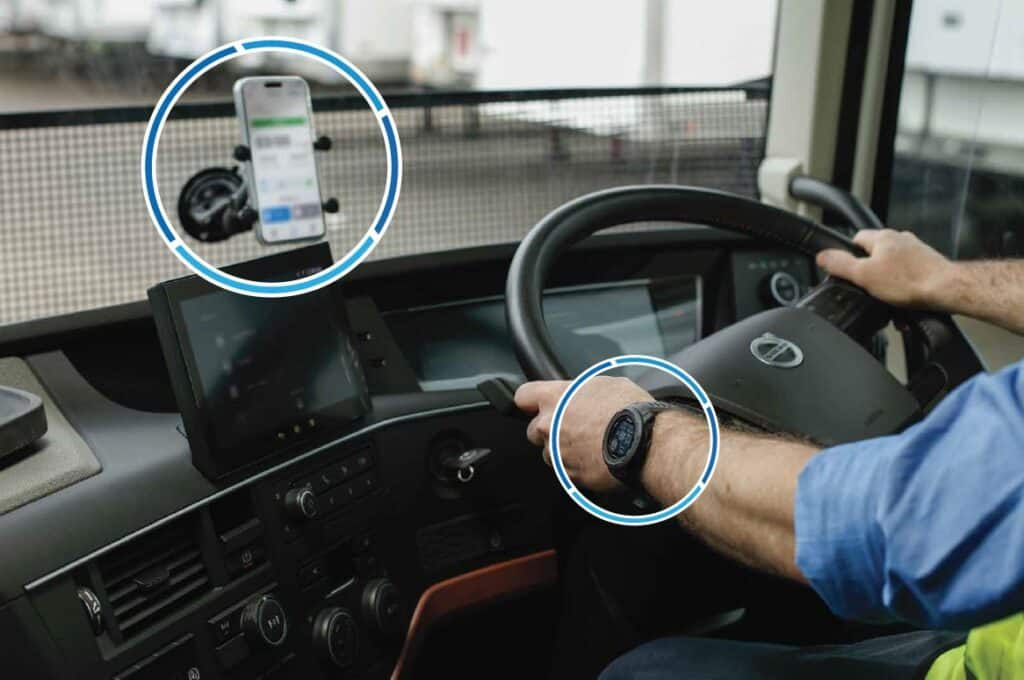
Health wearables are now moving into the fleets through test trials and acceptance by the drivers:
- Measuring of heart rate variability to assess stress and recovery
- Logging of sleep quality to determine chronic fatigue
- Links to actual driver fitness over time tied to activity trends
Trust, transparency, and data boundaries are essential. Properly presented, health monitoring supplements the health and safety agenda without the notion of monitoring.
Predictive Health and Preventive Action
Predictive health suggests a break from the typical complain-and-react approach to the more effective predict-and-prevent technique. Instead of dealing with the symptoms of the disease, it aims to find out the early paths associated with:
- Driver burnout prior to the accident occurrence
- Routes or Wbs with less alertness
- Workout patterns are causing physical strain
For example, if a fleet worries about tiredness costs and changes the schedule, or offers innovative driver assistance tools, or arranges a drive training course for target drivers, predictive health turns health from an expense to a variable that can be managed — supporting both commercial driver health outcomes and driver safety.
Driver Health and Insurance Cost Alignment
Insurance models for drivers are changing to the fast track. Underwriting that is solely based on past accidents is progressively being replaced by multi-factor assessments that incorporate health indicators and client behavior.
Insurers have begun to include:
- Risky schedules leading to sleep-related crashes
- Avoidable medical disqualifications
- Integrated health and safety programs
- Ongoing cycles of driver screening and fitness
Fleets that have active participation in the management of their drivers’ health save money by being less variable in claims, and control costs long-term — especially as new standards around safety and wellness tighten.
How Driver Health Is Reshaping Trucking Operations
| Area of Change | Traditional Approach | Emerging Model | Impact on Fleets |
|---|---|---|---|
| Driver Health Management | Periodic medical checks only | Continuous health monitoring and trend analysis | Early risk detection, fewer disruptions |
| Insurance Risk Assessment | Based on accident history | Multi-factor models including health indicators | Lower volatility in premiums |
| Medical Standards | One-time fitness clearance | Ongoing fitness-for-duty evaluation | Fewer sudden disqualifications |
| Health Technology | Minimal or absent | Telematics, wearables, predictive health tools | Data-driven decision-making |
| Driver Safety Strategy | Reactive, incident-based | Preventive and predictive | Reduced fatigue-related incidents |
| Driver Assistance Systems | Optional safety add-ons | Integrated health-support layer | Lower cognitive and physical strain |
| Driver Training | Compliance-focused | Health literacy and fatigue awareness | Higher engagement and retention |
| Fleet Health Management | Fragmented initiatives | Unified operational system | Long-term sustainability |
| Regulatory Compliance | Violation-driven enforcement | Preventive oversight and audits | Improved audit outcomes |
| Business Outcome | Health seen as cost | Health treated as infrastructure | Stronger performance stability |
Medical Standards, Transportation Standards, and Regulatory Change
Drivers’ health is directly related to the evolving transportation standards. The regulations are making a shift from the one-time medical clearance to the continuous fitness-for-duty evaluation based on the modern medical standard, driven by regulatory changes that increasingly connect compliance with measurable risk reduction.
The key trends found are as follows:
- Fewer sleep disorders among drivers due to fatigue management
- Ongoing observation of chronic diseases
- Health checks included at safety audits
- Expanded driver screening for high-risk positions
The new medical standards address the fact that driver health is not something static, but dynamic. Transport companies that go along with this view will be the ones that have a good level of compliance and necessary resource stability — and stronger health and safety performance overall.
Driver Fatigue as a Health and Safety Risk
Driver fatigue is now no longer seen as the disruption of a schedule. It is recognized as a health and safety risk and has long-term consequences.
Being sleep-deprived leads to:
- Delayed reflexes
- Mistaken choices
- Unstable emotions
- Increased cardiovascular risk
Shippers are reclassifying driver fatigue as both a medical and operational problem. However, if they overlook this first signal, they will be at risk of penalties, liabilities, and image damage — and reduced driver safety outcomes.
Fatigue Management for Truck Drivers
Driver Assistance as a Health-Support Layer
Functions of driver assistance technology shift more towards health facilitation than control. Systems like adaptive cruise control, lane support, and braking assistance help to decrease cognitive load during long work hours.
When smartly connected through telematics and predictive health insights, the drivers’ assistance gets even safer while drivers experience less physical and mental strain — supporting driver safety and health and safety goals without undermining driver autonomy.
Driver Training and Health Literacy
Providing technology alone does not suffice. Continuous driver training is of utmost significance in ensuring the long-term health of drivers and strengthening driver wellness habits under modern expectations.
New training programs consist of:
- Recognizing fatigue and giving feedback
- Managing sleep and recovery
- Dietary awareness on the road
- Techniques for dealing with stress
Drivers that understand their health may make better decisions, report the risks on time, and are able to work until they are productive, thus, avoiding liabilities and turnover — strengthening commercial driver health and fleet stability.
Fleet Health Management as a Unified System
Fleet health management is now a more structured system rather than a collection of standalone projects.
An effective framework consists of:
- Preventive health policies
- Technology-backed health monitoring
- Vigilant privacy boundaries
- Defined deactivate protocols
- Coordination with insurers and regulators
This way, drivers’ health is deeply embedded in performance, compliance, and long-time sustainability — aligned with new standards and ongoing regulatory changes.
Occupational Health and Driver Retention
Employee health is one of the major factors that retention relies on. Stress-related issues and chronic fatigue are the main reasons that capable drivers leave their positions, not their wages.
A strong health and safety engine result in:
- Less turnover
- Reduced recruitment cost
- Greater driver satisfaction
- Better safety records
Thus, in a labor-short market, driver health becomes a strategic asset.
The Prognosis: New Standards for the Future
The future driver health landscape will create a whole new set of expectations based on the increased usage of health technology, the linking of insurance perks to wellness metrics, better prediction models for health, more precise legal regulations, and a unified set of traffic and health and safety standards — effectively reshaping driver wellness as a measurable business pillar.
The strongest fleets will absorb health into the workflow and not isolate it as a single campaign.
Epilogue: Health as Infrastructure, Not Cost
A new phase of the driver health era is structural. Health is no longer a bonus, but it is a facility.
Technology, driver insurance models, transportation standards, and regulatory frameworks are converging into a single system where commercial driver health is at the heart of safety, performance, and financial stability.
In trucking, driver health is not near performance.
It is the basic state through which performance can be achieved.
Driver Health, Technology and New Standards: FAQ
What are the current trends associated with driver health in the trucking industry?
Driver health is transitioning from a sporadic medical check-up condition to a regular operational component. Fleets now have the duty to assess sleepiness, psychological health, and fitness trajectories over time, employing health technology, telematics, and structured programs. This shift to a health trend of which the managerial state of mind is the strongest reflects the standards of today, in which health relates directly to safety performance, insurance costs, and regulatory outcomes.
Why are insurance companies so concerned about driver’s health these days?
Insurance providers have been shifting their perspective about the driver’s health being a personal issue to that of a risk factor. Fatigue alongside unaddressed medical conditions and vanishing recovery patterns are the factors that have the strongest correlation with the accidents and related claims. However, commercial fleets, which, as a preventive measure, carry out a program on the health of their drivers often have a low-risk profile, which allows them to keep the premiums stable and curtail the long-term insurance liabilities.
What is the part played by technology related to driver health in the future?
Technology is more of a front-detection barrier rather than an exploratory one. Telematics, wearables, and data analytics throw a light on fatigue, increased workload, and improper recovery patterns. In the projected driver health model, change is rather than reacting after incidents. Technology proactively initiates preventive actions.
What is the influence of the new medical and transportation standards on the drivers?
New medical standards emphasize continuous fitness-for-duty verification rather than providing a one-time clearance. Transportation standards have also started incorporating health monitoring as a part of safety audit and compliance inspection. This action indicates that the driver’s health is seen as a process rather than an isolated event, entailing continuous monitoring as against periodic certification.
Is it fair to say that health monitoring can be viewed as surveillance?
Health monitoring is a support system in the right implementation, not being a surveillance channel. Trust, data privacy, and clarity of intention for the decision-making process are the prerequisites for the efficacy of such programs. Such an improvement in the driver safety and health and safety outcomes is envisioned, with the disclaimer that it doesnЂ™t generate more pressure or diminish the autonomy of the driver.
How does driver health reflect in fleet retention?
Poor management of health translates into situations like driver burnouts, fatigue-related departures, and typically, early exits. A fleet that is involved in driver wellness training, and follows the principle of giving truckers the supportive schedule, enjoys keeping the same experienced drivers for a longer time. Driver health is thus seen as a level of competition played against having to deal with it being just ‘cost-centre’ in a market facing labor deficiency.
Are driver assistance systems set to replace health programs?
No, they won’t replace them. The driver assistance system, it has a positively supportive relationship with health programs, albeit it can never take their place. This is due to the fact that the driver aid system lowers the cognitive load and the stress at the time when the driver is engaged in long shifts, while the health programs, on the other hand, are aimed at recovery, fitness, and long-term viability. They are both tear throughs to the driver safety and future health standards latter way around.